Posts

Agile for a team of one

Illustration of a lone developer at a desk at night with two glowing project streams branching from one laptop, one stream showing abstract team collaboration shapes and the other showing a house with a family, warm lamp light, city skyline through the window
Matt Lewandowski

Matt Lewandowski

Last updated 16/08/20266 min read

I've spent three years building Kollabe, a tool that exists so agile teams can estimate, retro, and standup without hating the process. A few months ago I started a second product, and it raised an awkward question: does any of my own advice survive when the whole team is one person working nights and weekends? The second product is AusBabysitters, a free directory where Australian families find verified babysitters and nannies. It started the way most side projects do, with a complaint I kept hearing. Parents around me in Sydney were paying a monthly subscription to a care platform just to see whether any sitters existed in their suburb, then paying a booking fee on top. That felt like a solvable problem: verify ID and Working With Children Checks properly, show every profile for free, take no commission, and let families and sitters sort the rest out between themselves. So that was the plan. Simple directory, a few suburbs, a messaging feature. What could go wrong.

The failure mode of nights-and-weekends projects

Side projects don't usually die from bad code. They die from thrash. You get four hours on a Tuesday night and spend ninety minutes deciding what to work on. You start the flashy feature, stall on the boring one, and after a month you can't say what changed or why. A team of forty fixes this with process. A team of five fixes it with conversation. A team of one has neither, which is how I ended up dogfooding my own product harder than any customer does. Three ceremonies survived the translation to solo work. The rest didn't, and I'll get to those too.

Estimation, with AI agents as my planning partners

Solo planning poker sounds like a punchline. Voting alone defeats the purpose, since the entire value of the exercise is surfacing disagreement. Except I'm not estimating alone anymore, and if you're building with AI coding tools, neither are you. I run estimation sessions where Claude Code votes alongside me after reading the actual codebase. The disagreements are real and they are frequently embarrassing. The best example: the sitter onboarding flow, the page where babysitters and nannies list a profile. I called it a 3. Profile form, photo upload, done by Sunday. The agent, having read the verification model, called it an 8. It was a 13. Working With Children Checks are run by each state and territory separately, so a NSW clearance, a Victorian one, and a Queensland Blue Card all have different formats, different registries, and different renewal rules. "Verify a sitter" was not a feature. It was seven features wearing a trench coat.

A fortnightly retro with an attendance of one

I already believed small teams need retros because conversation catches incidents and misses patterns. I did not expect the solo version to be the practice that saved the project. Every second Sunday I open a retro board, set a ten minute timer, and write cards to myself. What slowed me down, what worked, what am I about to hit. Then I vote, which feels ridiculous for about thirty seconds, and pick one action item. Illustration of a person looking at a wall of sticky notes where the same note visibly repeats many times, the repeated notes glowing softly while unique notes stay dim, flat editorial style Two retros in, the board showed me a pattern I would never have admitted in the moment. Week after week, the "what went well" column filled up with new suburb landing pages, and the "what slowed me down" column said messaging still isn't shipped. Suburb pages felt productive. They're easy, they're visible, and each one gave me a little hit of progress. Meanwhile the one feature that actually lets a family contact a sitter sat half-finished for a month, because it was hard and nobody was watching. The action item from that retro was blunt: no new suburb pages until messaging ships. It took two more weeks. It would have taken six months without the board rubbing my nose in the pattern, because the whole point of writing things down is that frequency becomes visible. My memory was happy to tell me I'd had four productive weeks. The cards said I'd had the same week four times.

Standups nobody reads

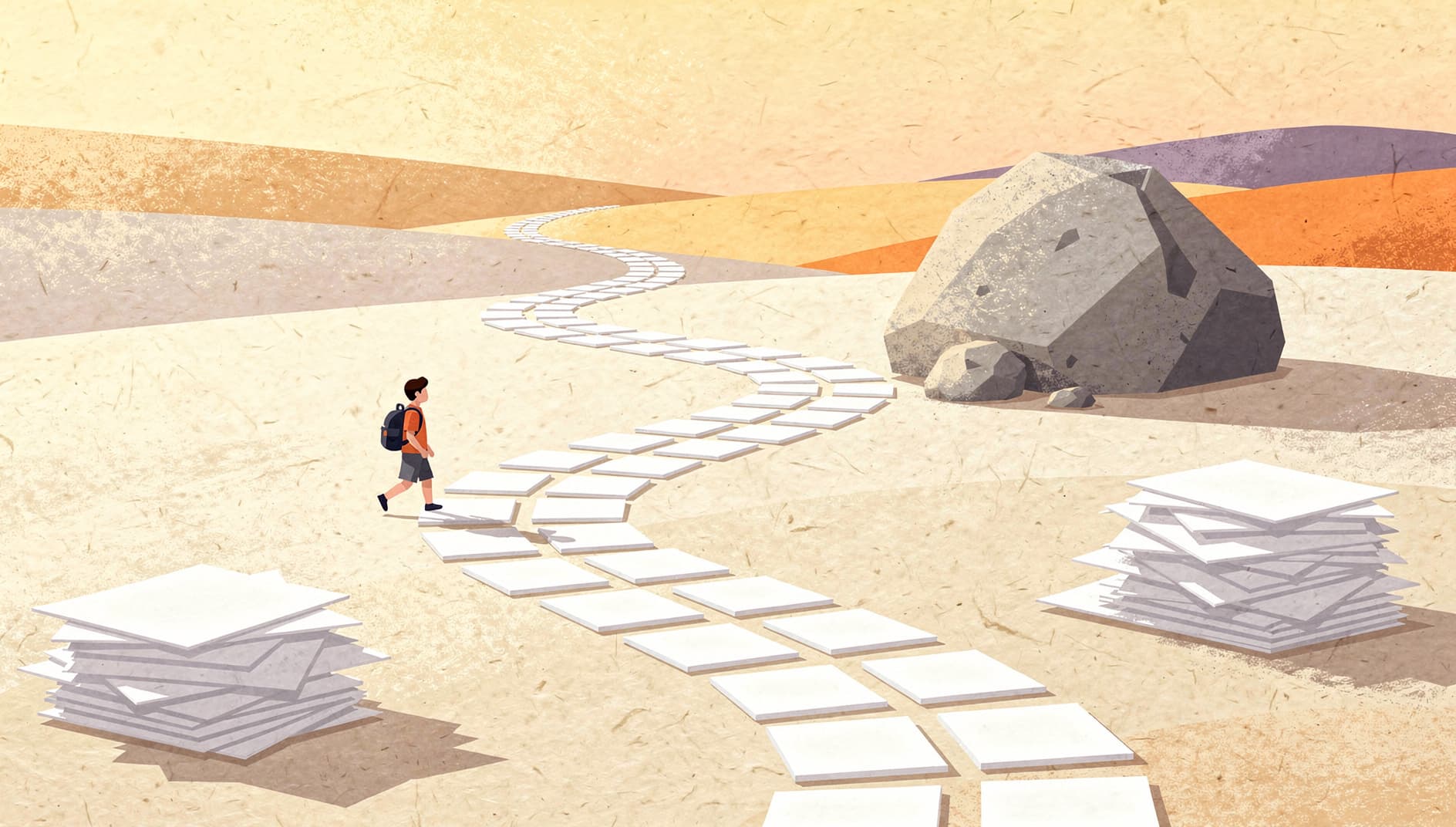
The third habit is the strangest one. Every morning I post an async standup update for AusBabysitters. Yesterday, today, blockers. The audience is nobody. It works for two reasons. First, "today" written at 7am is a commitment device. When I sit down at 9pm with my four hours, the decision about what to work on was already made by a better-rested version of me. The ninety minutes of Tuesday-night thrash just doesn't happen anymore. Second, the feed became the project's memory. When I came back from two weeks of Kollabe-only work after a big release, I didn't reverse-engineer my own half-finished branches. I read eight short updates and knew exactly where I'd left off, including the blocker I'd conveniently forgotten about. Illustration of a calendar of small daily notes forming a winding path that a tiny figure walks along, past paper piles and around an obstacle, clean vector style with a warm palette

What I dropped

Honesty requires the other half of the list. Sprint reviews are gone, because a demo with no stakeholders is theatre. Velocity tracking is gone, because a solo velocity chart only measures how busy your day job was that fortnight. Sprints themselves barely survive; I keep the fortnightly cadence for retros and nothing else, because committing to a fixed scope with wildly variable hours is a machine for manufacturing guilt. The pattern in what survived: every ceremony that made it is one where the artifact does the work. The board that shows repetition, the estimate that forces an explanation, the written update that outlives my memory. Every ceremony that died was one whose value was the meeting itself.

Where both products landed

AusBabysitters is live across Sydney and growing suburb by suburb, with verified sitters listing for free and keeping everything they earn. Kollabe got something out of the arrangement too. Several rough edges in the retro board got fixed within a day of me hitting them on a Sunday night, because I am now my own angriest customer. If you're running a team of one, or thinking about it, take the version of agile that fits in ten minutes and drop the rest without guilt. The ceremonies were always a means to an end, and it turns out the end survives a headcount of one just fine.

Purely alone, no. The value comes from disagreement. But estimating alongside AI agents that have read your codebase restores the disagreement, and with it the forced explanation that makes the practice useful.

A short written one, yes. Your memory hides patterns because each individual week feels fine. Ten minutes of cards every fortnight makes repetition visible, which is the one thing self-reflection in the shower never does.

Anything whose value is the live meeting: sprint reviews, velocity charts, formal sprint commitments. Keep the practices that leave an artifact behind, like estimates, retro boards, and written standups.