Posts

Do startups need retrospectives?

Illustration of a small startup team of four working in a cramped office with laptops, sticky notes on a single whiteboard, and a shipping calendar on the wall, energetic and slightly chaotic
Kelly Lewandowski

Kelly Lewandowski

Last updated 25/07/20267 min read

The question shows up in the agile subreddits every few weeks, usually from someone at a startup, usually phrased something like: we're five people, we sit in the same Slack channel, we ship every day, we have no sprints. Why would we schedule a meeting to talk about how we work when we already talk about how we work constantly? The replies are almost always worse than the question. "Inspect and adapt." "Continuous improvement." "It's in the Scrum Guide." None of those are reasons. They're slogans, and a founder burning runway can smell a slogan from a mile off. So here's the actual answer, including the part where the objection is right.

What the objection gets right

The retro most people picture is a 90-minute meeting with a facilitator, a timer, a Mad Sad Glad board, and eight action items that nobody looks at again. That format exists because a 40-person engineering org needs a formal channel for feedback. Informal channels do not scale past about a dozen people, so you build a ceremony to replace them. A startup has the informal channel. It works. Most of what a big-company retro surfaces on Thursday, a five-person team already knew on Tuesday and fixed on Wednesday. The cost is real too. Five people in a 90-minute meeting is most of an engineering day, every two weeks, at a company where the runway is measured in months. If someone tells you to run that because the framework says so, ignore them. You're not running Scrum. You're running a company.

The part it misses

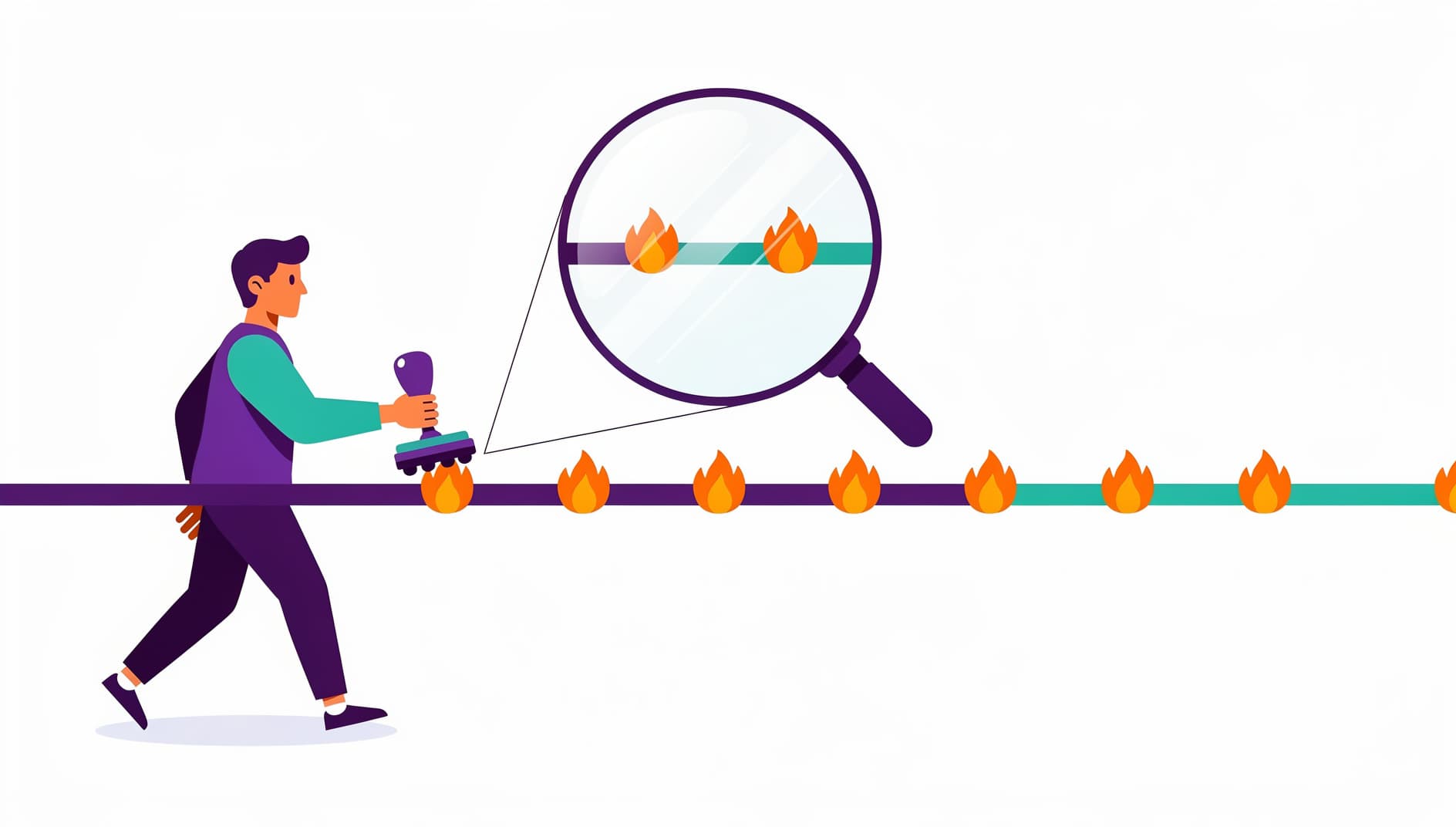
Constant conversation is excellent at incidents and useless at patterns. Here is what that looks like in practice. Staging eats an afternoon. Someone fixes it, posts in Slack, everyone moves on. Three weeks later it happens again, different symptom, same root. Someone fixes it again. Nobody says "this is the fourth time this quarter" because nobody is counting. Each individual instance was small enough to absorb, and the fix was fast enough that the pattern never became visible to anyone. Frequency is the information, and continuous feedback throws frequency away. You only see it when someone writes the same complaint down twice and the two pieces of paper end up next to each other. Illustration of a person repeatedly stamping out the same small fire on a long timeline, with the identical fire reappearing at intervals behind them, and a magnifying glass revealing the repeating pattern We looked at this across a million retro cards written by real teams. The most common complaints were not dramatic. Testing and QA topped the list at 10.2% of all complaint cards, followed by tickets and requirements at 8.1%, and deploys and releases at 4.9%. Communication, the thing everyone assumes is the problem, came in at 1.9%. Notice what those top entries have in common. They are all slow-burn structural problems that are nobody's emergency on any given afternoon. That is exactly why they never come up in the hallway and exactly why they compound.

Your feedback loop flows one direction

This one is specific to startups and founders consistently underrate it. At five people, the loudest voice in the room usually signs the paychecks. That doesn't make anyone a bad manager. It's what happens when the person with the most context and the most conviction is in every single conversation. Junior engineers don't push back on a founder in a live thread about the founder's own architectural call. A written retro where everyone submits before anyone reads is the cheapest fix for that I know of. Five minutes of silence, and it changes what you hear, because people will type a concern they'd never say out loud while the CTO is mid-sentence. If you want the longer version of why this matters, we wrote about psychological safety on agile teams separately.

The bill arrives at hire number seven

Startups don't stay five people. That's the whole point of the exercise. Decisions made in a hallway leave no record. The founding team remembers why the billing service is shaped the way it is and why nobody touches the import job. Hire six engineers in a quarter and none of them have any of that. They'll relitigate calls you settled in March, and you'll spend your quarter re-explaining instead of building. A retro history is the cheapest institutional memory you can buy, mostly because you were going to have the conversation anyway. Writing it down is the only extra cost.

The startup version of a retro

Twenty-five minutes, every two weeks, or monthly if your cycle is slower. No facilitator training, no icebreaker, and no sprint required.
  1. Write in silence for five minutes
    Three prompts is plenty: what slowed us down, what worked better than expected, what are we about to hit. Everyone types at the same time, nobody reads until the timer ends.
  2. Group and vote for five minutes
    Pull duplicates together. Duplicates are the signal you came for. Then everyone gets two votes.
  3. Discuss the top two items only
    Ten minutes, two topics. Everything else stays on the board as a record. You're not trying to solve the whole month, you're trying to find the thing that keeps quietly costing you days.
  4. Leave with one change and a name attached
    One. Not a list. Assign it to a person and give it a date, then check it at the start of the next retro.
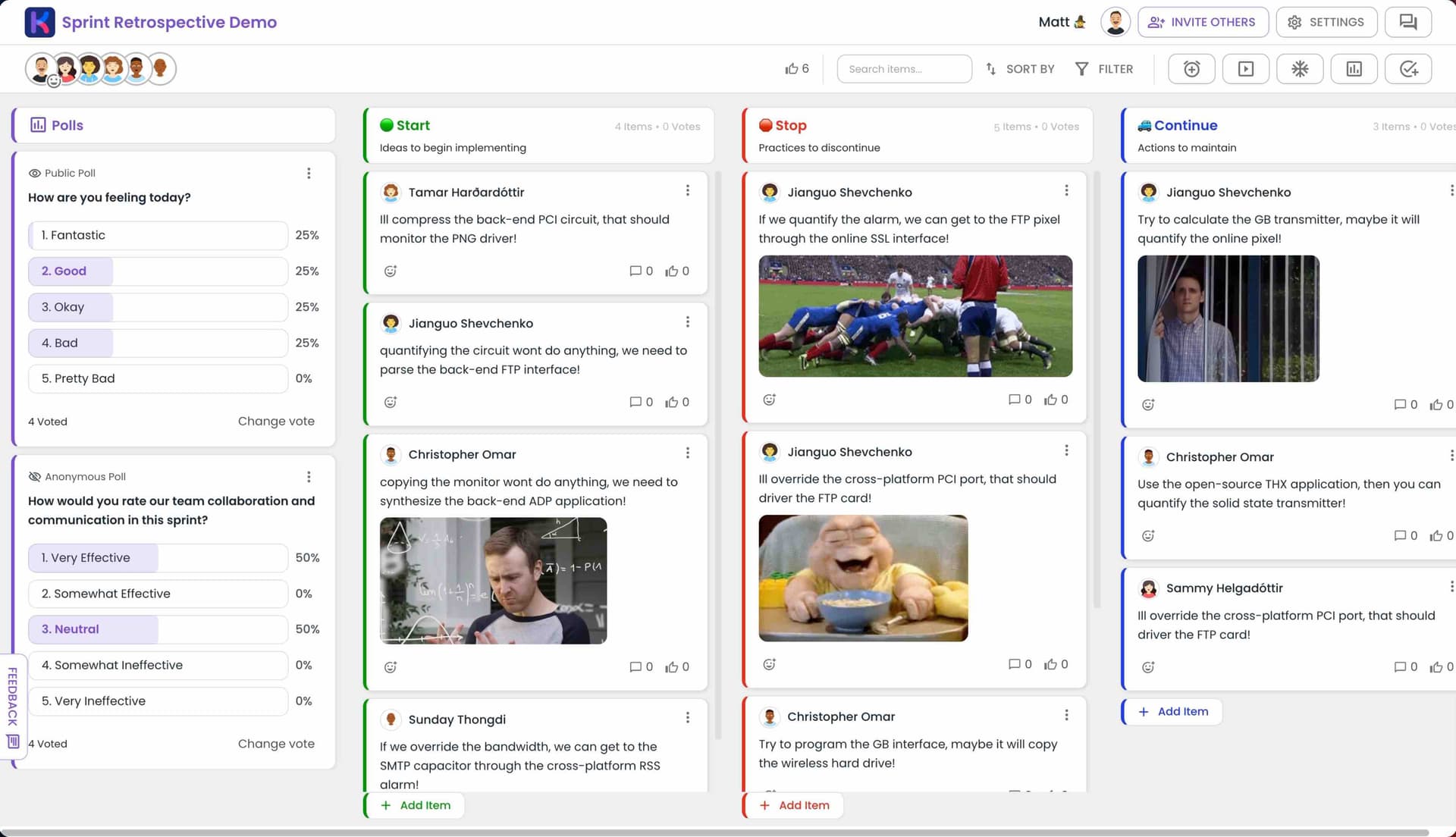
Async works even better at this size. Nobody needs to be in a room. Post the board Monday morning, let people add cards through the day, and spend fifteen minutes together on the top two. A Kollabe retrospective board with Start, Stop, and Continue columns filled with cards from a five-person team, alongside public and anonymous team polls

When you can genuinely skip it

I'd rather be honest about this than sell you a ceremony.

Two co-founders who pair all day, pre-product, no employees. Your Tuesday walk is the retro. Do it on purpose once a month and write down what you decide.

The cycle where everything went sideways on one incident. Run a proper postmortem instead, which is a better format for a single event with a clear cause.

You already run a monthly written review that asks what is slowing you down. That is a retro. Keep it and skip the second meeting.

What doesn't count as a valid skip: "we're too busy." Five people for 25 minutes is roughly two hours of company time a month. One repeat deploy failure costs more than that in a single afternoon, and you've had four of them.

So, do you need one

If you're a startup with more than three people and any intention of hiring, yes, but not the version you're picturing. What you need is a short recurring habit of writing things down and looking at what repeats. The ceremony is optional. The record is not. Start with a board and three prompts. If you want somewhere to put it, Kollabe's retrospectives are free for small teams, work async, and let people submit anonymously so the founder's opinion isn't the first thing everyone reads. Our retro template generator will build you a format from a one-line description of your team if you'd rather not pick one yourself.

Every two weeks works for most teams shipping continuously. Monthly is fine if your cycle is slower or the team is under five people. More detail in our guide on how often to run retrospectives.

Yes. Tie it to the calendar instead of an iteration. A retro needs a period to look back on, and "the last two weeks" is a period.

No. At startup size, whoever schedules it can run it. The one rule worth enforcing is that everyone writes before anyone talks.

Anonymous submission helps even when everyone can guess who wrote what, because it removes the moment of deciding whether to speak up. Try it for two rounds and compare what lands on the board.