
Posts

Your team ships faster with AI. Here's why you need retros more than ever

A software team gathered around a table having a lively discussion while AI-related icons and code symbols float in the background, contrasting human collaboration with digital automation
Kelly Lewandowski

Kelly Lewandowski

Last updated 02/03/20267 min read

Your developers are using Copilot, Claude Code, Cursor, or some combination of all three. Pull requests are merging faster. More code is shipping per sprint than ever before. By every individual metric, your team looks more productive. But look at the numbers: 70% of developers say AI increases their personal productivity, while only 17% say it improves team collaboration. That gap should worry you. AI coding tools are solving the wrong bottleneck. Most teams weren't blocked by typing speed. They were blocked by building the wrong thing and accumulating technical debt nobody talked about. AI makes both of those problems worse by letting you move faster without checking direction. Sprint retrospectives are the fix. Not because they're a nice agile ritual, but because they're one of the few structured moments where a team stops building and starts asking whether the work actually matters.

The productivity paradox nobody talks about
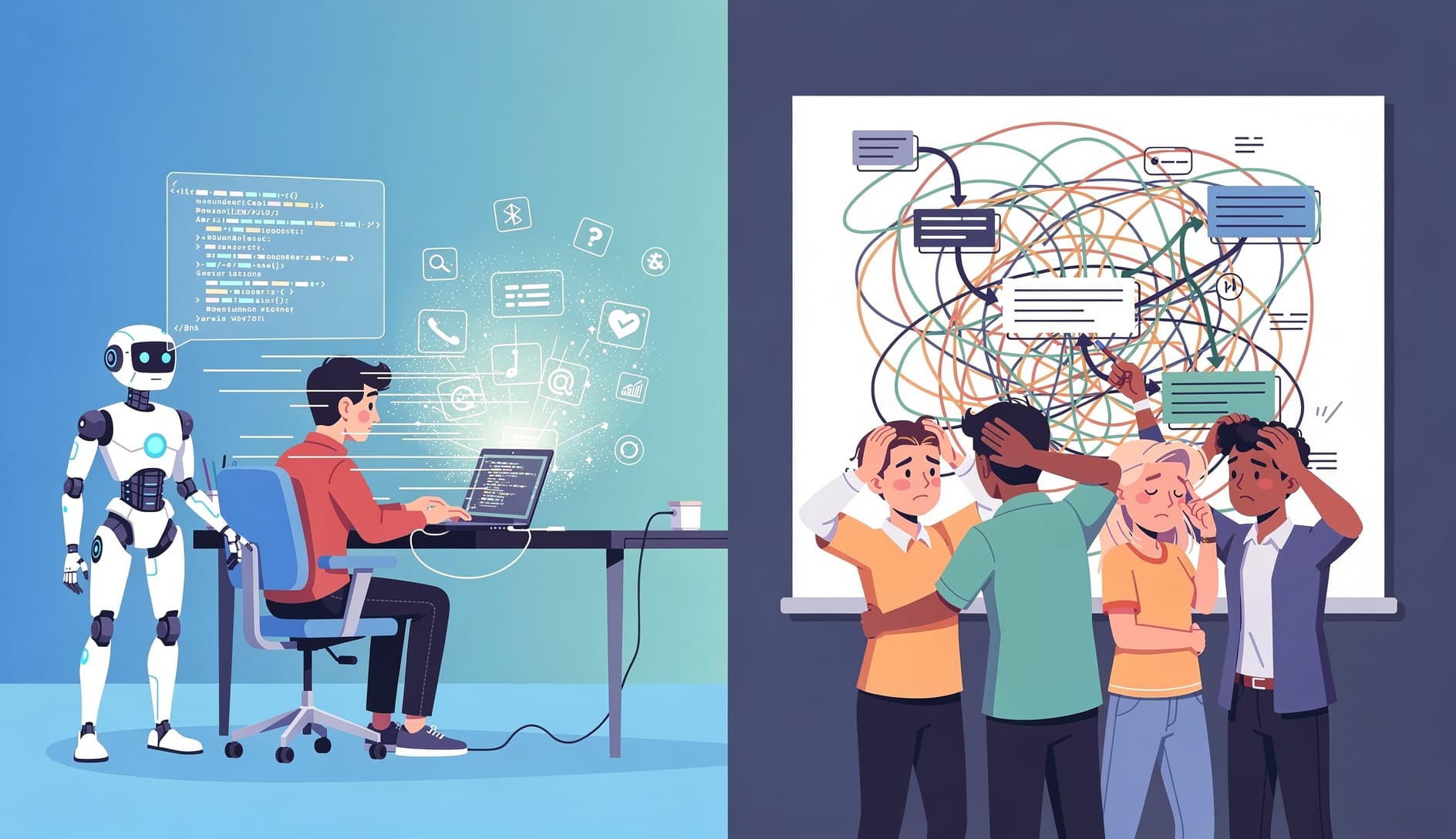
The headline numbers on AI coding tools look impressive. GitHub reports that Copilot users complete tasks 55% faster. Accenture saw an 84% increase in successful builds after rolling it out. McKinsey found 20-30% efficiency gains in high-performing teams. But dig deeper and the picture gets complicated. A randomized controlled trial by METR found that experienced developers using AI tools took 19% longer to complete tasks, while believing they were 20% faster. That's a 40-percentage-point gap between perception and reality. Google's DORA 2024 report found that a 25% increase in AI usage correlates with a 7.2% decrease in delivery stability. GitClear's analysis of 211 million lines of code showed code churn (new code revised within two weeks) jumped from 3.1% to 7.9% between 2020 and 2024, while refactoring dropped from 25% to under 10%. More code is shipping. Whether it's the right code is a different question. A split illustration showing one side with a single developer coding rapidly with AI assistance, and the other side showing a team scratching their heads looking at a confusing product, representing speed without alignment

AI handles the "how," retros handle the "should we"

AI tools are good at a narrow set of things: generating boilerplate and autocompleting patterns. They handle the "what" and "how" of building software faster than any human can. What they can't do is tell you whether the thing you're building is worth building. That judgment call lives in the conversations between humans. Should we build this feature? Is this the right approach? Are we solving the actual customer problem? Retrospectives are where those conversations happen. When a team reflects on the sprint, they're asking whether the work they shipped moved the needle, not just listing what went well. As AI compresses the build cycle, the feedback loop with customers needs to tighten, not loosen. You can ship a feature in two days instead of two weeks. That's only valuable if it was the right feature.

More decisions per sprint, more room to diverge

Think about it this way. If AI lets your team ship 2x the work per sprint, you're also making roughly 2x the decisions per sprint. Which stories to pick up, how to implement them, what tradeoffs to accept, which corners to cut. Each decision is a point where team members can silently go in different directions. Before AI, the natural pace of coding created organic sync points. Pair programming, PR reviews, hallway conversations about tricky implementations. These informal checkpoints caught problems early. A two-year longitudinal study of developers using AI tools found that AI adoption shifts work toward individualized coding tasks and away from collaborative coordination. Developers spend more time in flow states with their AI assistant and less time talking to each other. The collaboration problems that existed before AI (knowledge silos, communication breakdowns, unclear responsibilities) remained completely unresolved. When your team is spending 90% of the sprint heads-down with an AI pair programmer, the 60 minutes you spend in a retro might be the most important hour in the entire sprint.

AI-generated code creates problems only humans can catch

CodeRabbit's analysis of 470 open-source pull requests found that AI co-authored code contained 1.7x more major issues, 75% more logic errors, and 2.74x higher security vulnerabilities than human-written code. Meanwhile, over 40% of junior developers admit to deploying AI-generated code they don't fully understand. This isn't a crisis. It's a pattern that needs team-level conversation. Team members gathered around a screen reviewing code together, with some pointing at potential issues, depicting collaborative code review and knowledge sharing Individual developers can't solve this alone because the problems are systemic. When one person's AI-generated utility function quietly duplicates another team member's existing library, that's a codebase-level issue. When AI-suggested shortcuts create technical debt that compounds over multiple sprints, nobody sees the full picture unless the team talks about it. Retrospectives are where these patterns surface. "Are we reviewing AI output carefully enough?" is a retro question. "Where are knowledge gaps growing?" is a retro question. "Are we accumulating debt faster than we realize?" is a retro question.

What to actually discuss in retros when your team uses AI

Standard retro formats still work, but the questions need updating. These five topics come up most for AI-assisted teams.

AI tool effectiveness

Where did AI actually help this sprint? Where did it slow you down or send you in circles? Teams that track this build a shared sense of when to lean on AI and when to step back.

Knowledge distribution

Who understands the code that shipped? AI makes it easy for one person to generate an entire feature alone. That's a bus factor risk. Use the retro to flag areas where knowledge is concentrated in one person.

Customer connection

Did the speed gains translate into customer value? Shipping twice as fast means nothing if you're shipping features nobody asked for. The retro should connect sprint output back to customer feedback and product goals.

Code quality signals

Is churn increasing? Are PRs getting rubber-stamped because the volume is too high for thorough review? Are you seeing more bugs in production from AI-generated code? These are leading indicators that need team discussion, not individual heroics.

Team norms around AI

Every team develops informal rules about AI usage: when to use it, when not to, how much review is expected. The retro is where you make those norms explicit and adjust them based on what's actually happening. Try using a retrospective template designed for these conversations, or adapt your existing format with AI-specific prompts.

The meetings you don't automate are the ones that matter most

Google's DORA 2025 report puts it plainly: "AI makes good teams great. And bad teams worse, faster." The practices that separate those two categories, like psychological safety and honest feedback, are what retrospectives are built around. There's a temptation to automate everything when AI is involved. AI-generated standup summaries. AI-analyzed retro boards. Some of this is useful. But the value of a retrospective is the conversation itself. It's the moment where a junior developer says "I didn't understand that architecture decision" or a senior engineer admits "I think we over-scoped this sprint." Those moments don't happen in Slack threads or Jira comments. They barely happen in PR reviews. They happen in retros, when the team has carved out space to be honest about how the work is going. As AI takes over more of the mechanical work of building software, human conversations become rarer. And rarer means more valuable.

The data suggests yes. Stack Overflow's 2025 survey found only 17% of developers say AI tools improved team collaboration, the lowest-rated impact across all categories. A longitudinal study confirmed AI shifts work toward individual tasks and away from collaborative coordination.

Add AI-specific topics: tool effectiveness, knowledge distribution, code quality signals, and team norms around AI usage. The core format doesn't need to change, but the questions should reflect how AI is affecting the team's work.

The opposite. Faster shipping means more decisions per sprint, more surface area for misalignment, and a tighter feedback loop needed with customers. Teams that skip retros in favor of speed tend to accumulate problems that compound until they hit a wall.

Silent divergence. Team members each working with their own AI tools, making independent decisions, building up knowledge silos and technical debt that nobody sees until it's expensive to fix. Retros catch this early.