Posts

How to run agile ceremonies across time zones

Illustrated globe with team members working at desks in different cities connected by glowing lines, clocks showing different times above each location
Kelly Lewandowski

Kelly Lewandowski

Last updated 11/03/20267 min read

Your team spans New York, Berlin, and Bangalore. That's a 10.5-hour spread. The scrum guide was written assuming everyone could gather in the same room, and it shows. Sprint planning at 9am Eastern is 7:30pm in India. A retro at 4pm Berlin time catches New York at 10am but Bangalore at 8:30pm. Most teams respond by rotating who gets the bad meeting time. That helps with fairness but doesn't fix the core problem: you're forcing synchronous meetings on an asynchronous reality. The better approach is to decide which ceremonies actually need real-time discussion and which ones work better async. Then design your schedule around the overlap window you actually have.

Find your overlap window

The overlap window (sometimes called "golden hours") is the block of time when everyone on your team is within normal working hours. For most distributed teams, this is 2-4 hours. Some teams get less. Map it out:
LocationWorking hours (local)UTC equivalent
New York9am - 5pm14:00 - 22:00
Berlin9am - 5pm08:00 - 16:00
Bangalore9:30am - 6:30pm04:00 - 13:00
Overlap14:00 - 16:00
That gives you two hours. Guard them. These hours are for the meetings that absolutely require live conversation. Everything else happens async.

Which ceremonies need to be synchronous

Not all scrum ceremonies carry equal need for real-time interaction. Here's how they break down:
CeremonySync needed?Why
Daily standupNoStatus updates work better written for distributed teams
Sprint planningMostly yesNegotiating scope requires back-and-forth discussion
Sprint reviewYesLive feedback from stakeholders is the whole point
Sprint retrospectiveYesHonest discussion about team dynamics needs real-time presence
Backlog refinementHybridPre-read async, then sync for questions and estimation
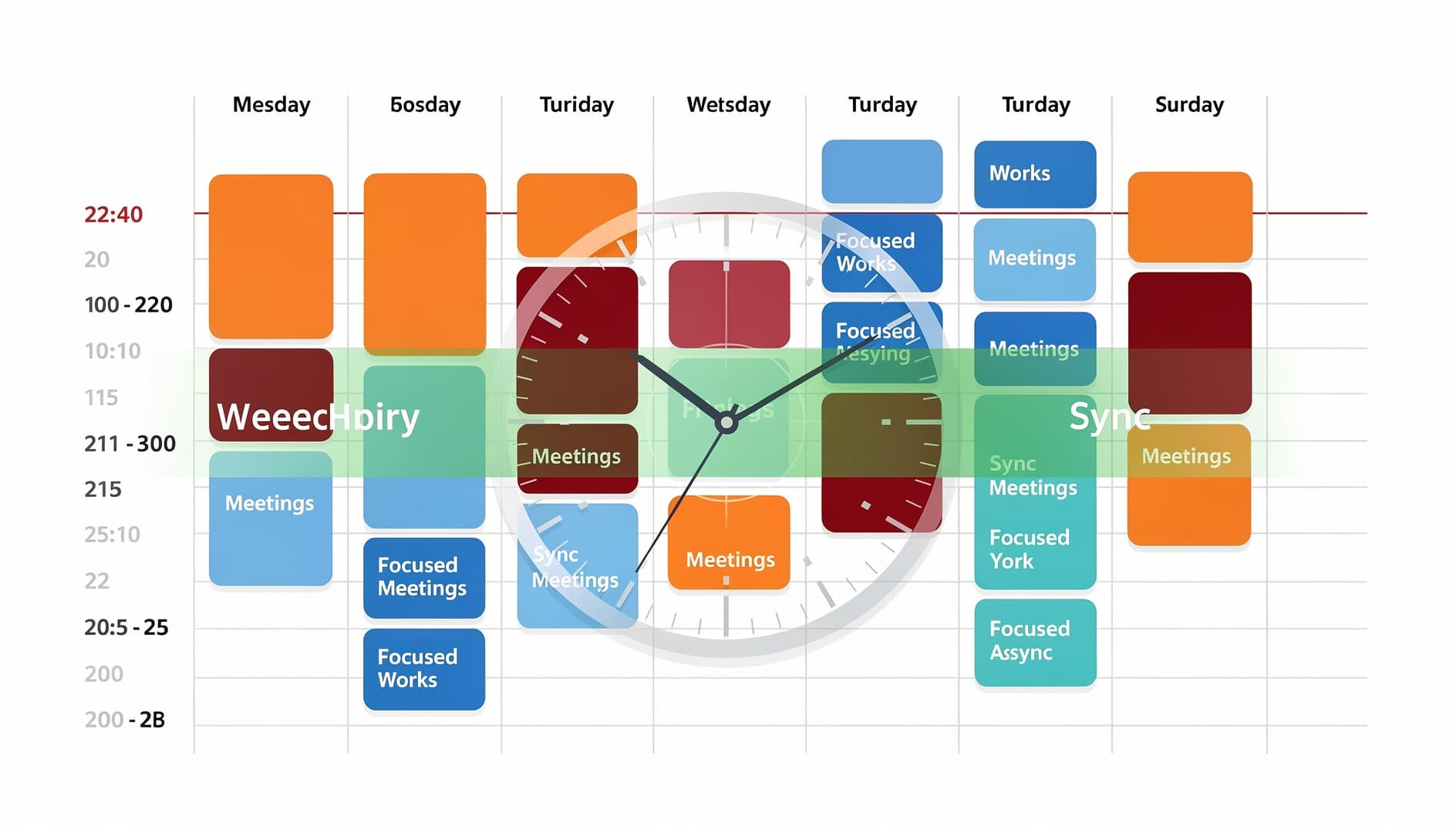
The daily standup is the easiest win. Moving it async saves your overlap window for ceremonies that actually need it. Illustrated calendar view with ceremony blocks color-coded as sync and async, a clock overlay showing overlap hours highlighted in green

Go async-first with standups

Written standups outperform live meetings for distributed teams. Everyone posts their update when they start their day, reads teammates' updates at their own pace, and comments on blockers they can help with. No timezone math required. The research backs this up. GitLab reported async standups reduced meeting hours by 37% while projects shipped faster. Teams using written updates also get a searchable record of daily progress, which is a side benefit you never get from a Zoom call. If your team is still doing synchronous standups across three or more time zones, it's worth questioning why. Kollabe's standup tool was built for this exact scenario: persistent daily rooms, async updates, and AI summaries that surface blockers automatically.

Sprint planning: async prep, sync decisions

Sprint planning is where async prep pays off most. The actual negotiation of sprint scope needs live discussion, but a huge chunk of planning is just information transfer that can happen beforehand.
Async: share context ahead of time
The Product Owner posts candidate backlog items 24-48 hours before planning. Each item includes acceptance criteria, dependencies, and any context the team needs. Team members read and post questions async.
Async: estimate before the meeting
Run estimation using async planning poker. Everyone votes independently, and you can see where the big disagreements are before anyone gets on a call.
Sync: negotiate and commit
Use your overlap window for the live session. Since everyone has already read the items and estimated, you can focus the meeting on resolving disagreements, discussing trade-offs, and setting the sprint goal. This cuts a 2-hour planning session down to 45-60 minutes.

Retrospectives: protect this meeting

Retros are the one ceremony you should fight hardest to keep synchronous. The candid, sometimes uncomfortable conversations about team dynamics don't translate well to async formats. Text lacks tone. Typed responses feel less safe than spoken ones. And the group energy that makes retros productive is hard to replicate in a document. That said, you can make distributed retros work well:
  • Async input, sync discussion. Have team members add items to the retro board before the meeting. This gives quieter team members (and those in less favorable time zones) equal opportunity to contribute. Then use the sync session for voting, grouping, and discussion.
  • Rotate the time slot. If your overlap window puts one timezone at the edge of their workday, alternate the meeting time every other sprint.
  • Keep it tight. Distributed retros lose energy faster than in-person ones. Aim for 60 minutes max. Start with a quick icebreaker to warm people up, then get into it.
  • Use anonymous voting. This matters even more in distributed teams where power dynamics can be amplified by screen presence.
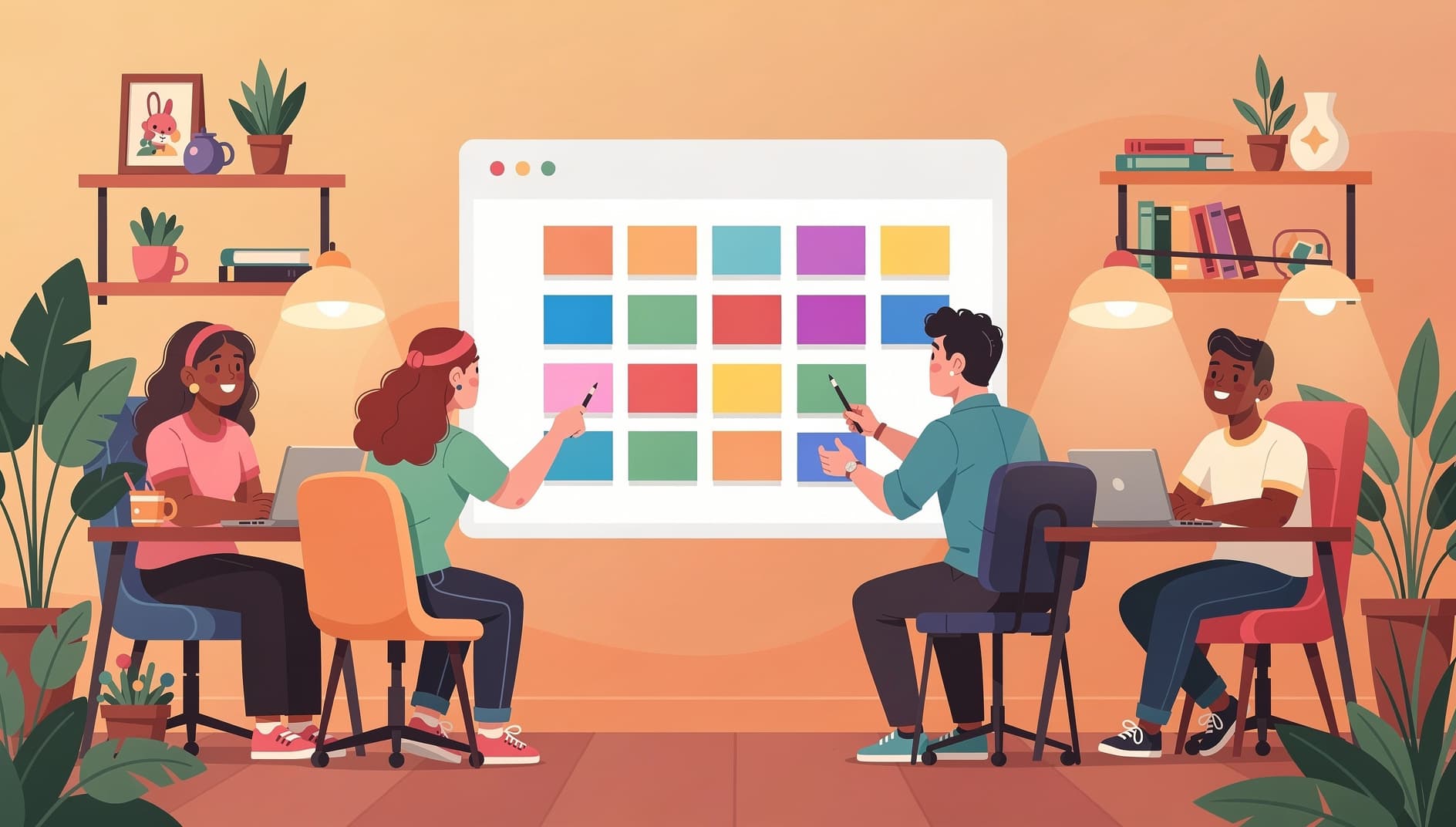
Illustrated team members in different home offices participating in a virtual retrospective, adding colorful sticky notes to a shared digital board

Sprint reviews across time zones

Sprint reviews need stakeholder presence, which complicates scheduling. Stakeholders may span even more time zones than the dev team. Two approaches that work: Record and replay. Run the live review during your overlap window with whoever can attend. Record it. Share the recording with async stakeholders along with a feedback form. Set a 48-hour window for written feedback before the next sprint starts. Split reviews. If you have stakeholders in two distinct timezone clusters, run two shorter reviews instead of one long one. Same demo, different audiences. This doubles the facilitation effort but gets better feedback than a recording ever will.

Setting team agreements

The schedule alone won't save you. Distributed teams need explicit agreements about how async communication works. Document these and revisit them every few sprints:
  • Response time expectations. How quickly should someone reply to an async question? 4 hours during their workday is a common standard.
  • Handoff protocols. When someone in Berlin finishes work and a dependency now sits with Bangalore, how is that handed off? A message in a shared channel? A ticket status change?
  • Meeting-free blocks. Protect at least 4 hours of uninterrupted time per day for deep work. Overlap hours are for collaboration; the rest is for building.
  • Escalation paths. What counts as urgent enough to ping someone outside their working hours? Define this clearly so people can actually disconnect.

A sample weekly schedule

Here's what a sprint week might look like for a team across New York, Berlin, and Bangalore with a 2-hour overlap (14:00-16:00 UTC):
DayOverlap window activityAsync
MondaySprint planning (sync, 60 min)Standup updates, pre-read planning items
TuesdayAvailable for ad-hoc syncStandup updates, refinement pre-read
WednesdayRefinement (sync, 45 min)Standup updates, estimation via planning poker
ThursdayAvailable for ad-hoc syncStandup updates
FridayRetro or review (sync, 60 min)Standup updates, retro board input
Notice the overlap window is used for at most one meeting per day. The rest of the time, people build things. Illustrated weekly planner with sync meeting blocks in warm colors during overlap hours, and async task blocks in cool colors spread across the full day

Common mistakes

Treating every ceremony the same. Some need sync, some don't. Applying the same format to all five wastes either people's time or the meeting's potential. Defaulting to the HQ time zone. If leadership is in New York and every meeting lands during East Coast business hours, your Berlin and Bangalore teammates are constantly accommodating. Rotate or find the true middle ground. Over-communicating to compensate. Adding more meetings doesn't fix a timezone problem. It makes it worse. Go async-first, then add sync touchpoints only where real-time conversation is necessary. Skipping documentation. In a co-located team, decisions spread through hallway conversations. Distributed teams don't have hallways. If a decision isn't written down, it didn't happen for anyone who wasn't in the room.

Wrapping up

Running ceremonies across time zones isn't about finding the perfect meeting time. It's about accepting that the perfect time doesn't exist and designing your process around that constraint. Go async where you can, protect your overlap window for what truly needs real-time discussion, and write everything down.

Two hours is the practical minimum for running essential sync ceremonies. Three to four hours is more comfortable and lets you keep some ad-hoc collaboration time. If you have less than two hours, lean heavily on async and consider running shorter, more focused sync sessions.

Yes. If one group consistently gets early morning or late evening meetings, resentment builds and participation drops. Rotate the inconvenient slot every sprint or every two sprints.

Partially. Gathering input async (adding items to a board, voting) works well. But the discussion portion benefits from real-time interaction where people can read tone and build on each other's ideas. A hybrid approach, async input with a shorter sync discussion, is the best compromise.

You need async standup support, async-capable planning poker, and shared retro boards that people can contribute to before meetings. Kollabe covers estimation, retrospectives, and standups with async workflows built in.